Scientists worried that AI is “stealing” their ideas are really flagging three distinct technical risks: data retention by vendors, model training on prompts, and convergent outputs that mimic unpublished work—each with different mitigations.
The Core Concern, Stated Plainly
Researchers routinely paste hypotheses, draft methods, and unpublished data into chatbots like ChatGPT, Claude, or Gemini to brainstorm, debug code, or get feedback. The fear: that these inputs get stored, used for future model training, or surfaced (even indirectly) to other users asking similar questions. This isn’t paranoia—it’s a legitimate data governance question with concrete technical answers.
Breaking Down “Idea Theft” Into Real Mechanisms
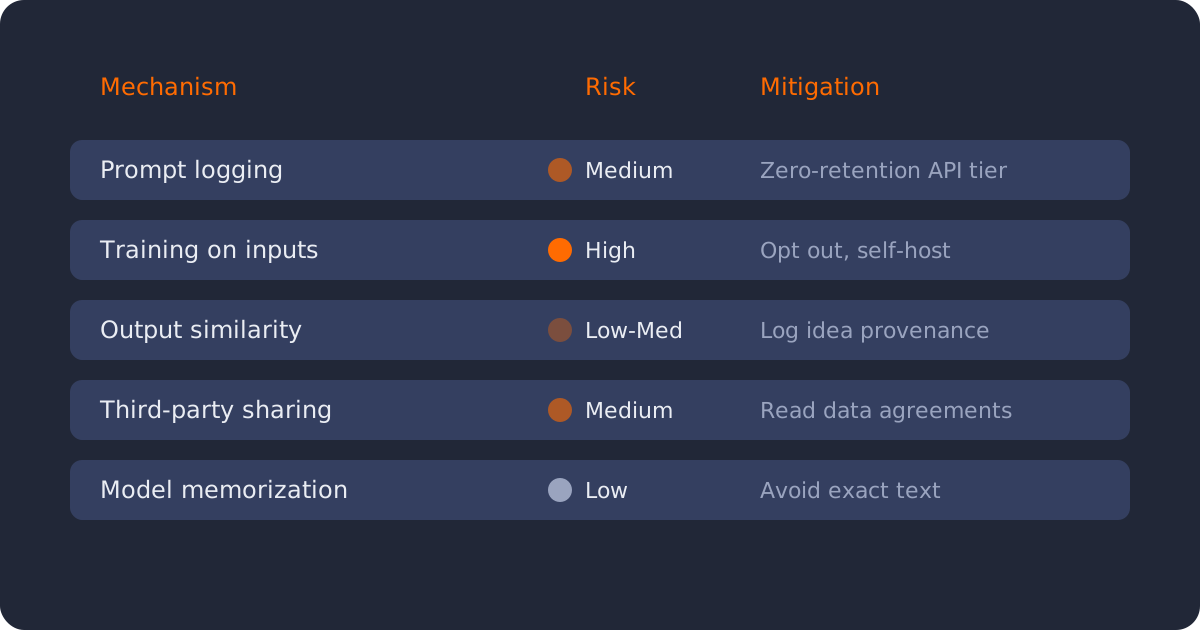
| Mechanism | What Actually Happens | Risk Level | Mitigation |
|---|---|---|---|
| Prompt logging | Vendor stores your input/output pairs on servers | Medium | Use enterprise/API tier with zero-retention clauses |
| Training on inputs | Your prompts become training data for future model versions | High (if consumer tier) | Opt out via settings, or use self-hosted models |
| Output similarity | Model generates similar ideas for other users via pretraining, not your specific prompt | Low–Medium | Document idea provenance (timestamps, drafts) |
| Third-party data sharing | Inputs shared with partners/integrations | Medium | Read DPAs; avoid tools without clear data flow docs |
| Model memorization | Rare verbatim leakage of training data in outputs | Low (mostly mitigated in frontier models) | Avoid pasting exact unpublished text; paraphrase |
The table above separates the plausible risks (logging, training consent) from the unlikely but feared ones (direct idea leakage to competitors), which is the actual technical distinction scientists need to make decisions around.
What’s Actually Happening Under the Hood
Most consumer-facing AI tools operate under a data policy like this:
User Input → Logged to Vendor Servers (retention: 30 days–indefinite)
           → Reviewed for Abuse/Safety (human-in-loop possible)
           → [Optional] Used for Model Fine-Tuning (if training on user data = ON)
           → Discarded or Archived
For most major providers (OpenAI, Anthropic, Google), enterprise and API tiers default to zero data retention for training purposes, while free consumer tiers often opt you in by default. The fix isn’t avoiding AI—it’s checking which tier you’re on and what the settings say.
Practical Steps for Researchers
- Check your tier’s data policy explicitly. API access and enterprise plans (OpenAI API, Claude for Work, Gemini Enterprise) typically exclude prompts from training by default.
- Disable training opt-ins in consumer apps. ChatGPT, Gemini, and Claude all have settings to turn off “improve the model” style toggles.
- Use local/open-weight models for sensitive drafts. Running Llama, Mistral, or similar via Ollama keeps data entirely on your machine—zero vendor exposure.
- Timestamp your work independently. Git commits, lab notebooks, or preprint servers (arXiv) establish provenance regardless of AI involvement.
- Treat AI chat logs like email—assume they could be reviewed, and avoid pasting full unpublished manuscripts or proprietary datasets.
Bottom Line
The “AI is stealing my ideas” fear usually resolves into a data-retention and training-opt-in problem, not a sci-fi plagiarism scenario. Scientists can largely neutralize the real risk by using enterprise/API tiers with zero-retention guarantees, running local open-weight models for sensitive work, and maintaining independent provenance records (Git, arXiv, lab notebooks) for anything genuinely novel.