Pulse Local is a new Mac budgeting app that runs its AI models entirely on your machine, meaning your financial data never leaves your laptop.
What It Is
Built by solo developer Niz and shared on Hacker News, Pulse Local is a budgeting app for Apple Silicon Macs (currently in beta) that uses a fine-tuned local model plus thousands of hardcoded rules to answer natural-language questions about your spending — e.g., “how much did I spend on dining last month?” — without any network calls to a cloud backend.
The core pitch is privacy-by-architecture, not privacy-by-policy: the app technically cannot leak data because it has no pipeline to send it anywhere in local mode.
Key Facts
- Platform: macOS, Apple Silicon only (M1 and later), beta release
- Pricing: Free, with optional paid support to fund development
- Account requirement: None needed in local mode
- Data handling: No analytics, no crash logs, no telemetry
- Network activity: Limited to downloading the AI model(s) and occasional app updates
- AI backend: A fine-tuned local model combined with rule-based logic embedded in the app binary
- Ledger storage: Kept entirely on-device
How It Compares to Typical Budgeting Apps
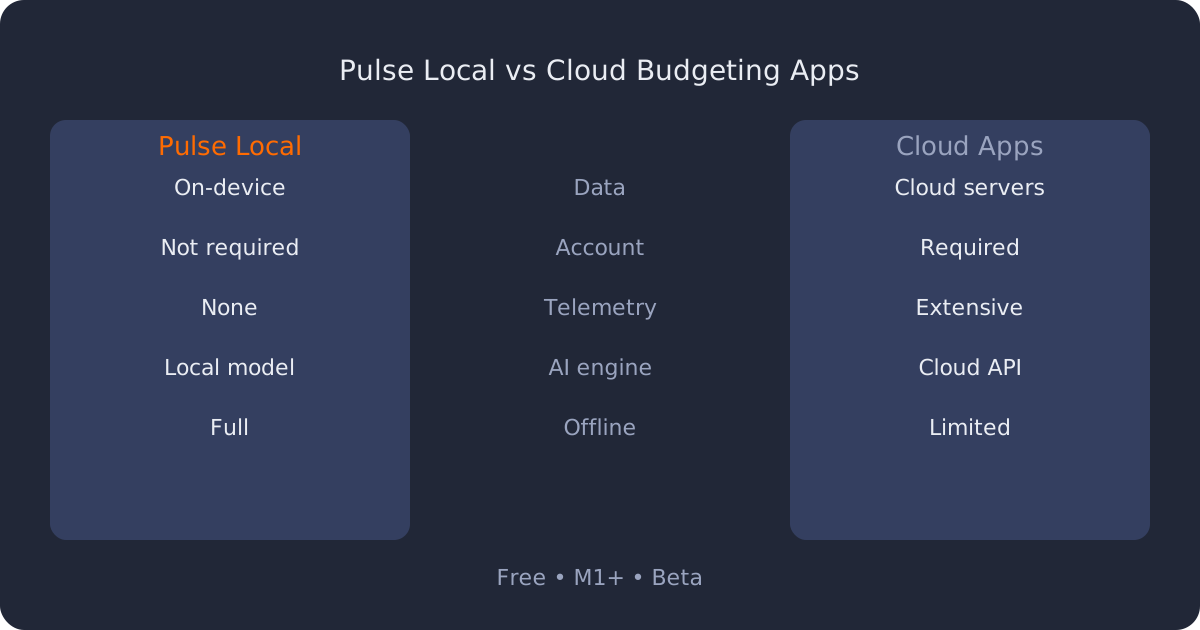
| Feature | Pulse Local | Typical Cloud Budgeting App (e.g., Mint-style) |
|---|---|---|
| Data location | On-device only | Vendor’s cloud servers |
| Account required | No (local mode) | Yes |
| Analytics/telemetry | None | Usually extensive |
| AI processing | Local inference | Cloud API calls (often third-party LLMs) |
| Offline functionality | Full | Limited or none |
| Bank sync | Not emphasized (manual ledger focus) | Core feature via Plaid-like services |
| Cost | Free + optional donations | Freemium/subscription |
Why It Matters
Most “AI-powered” finance apps route your transaction history through a third-party LLM API to generate spending insights — a dealbreaker for privacy-conscious users handling sensitive financial data. Pulse Local’s architecture sidesteps that entirely by shipping the model with the app and running inference locally, following the same local-first trend seen in on-device transcription and note-taking tools.
The tradeoff is scope: local-only models are typically smaller and less capable than frontier cloud LLMs, and the app currently lacks the bank-sync automation that drives adoption of apps like Mint or YNAB. The rule-based layer compensates for some of this by handling deterministic categorization without needing model inference at all.
Example: Local Query Flow
User query: "What did I spend on groceries in September?"
     ↓
Rule engine checks category tags in local ledger
     ↓
Fine-tuned local model parses natural language intent
     ↓
Response generated on-device (no API call)
     ↓
Answer displayed in-app
No step in this flow touches an external server — the entire round trip happens within the sandboxed app on the user’s Mac.
Bottom Line
Pulse Local targets a narrow but growing niche: users who want AI-assisted budgeting without trusting a cloud vendor with their bank transactions. It’s free, Apple Silicon–only, and still in beta, so expect rough edges — but the zero-telemetry, fully local design is a meaningful differentiator in a category dominated by cloud-dependent fintech apps.